
China regulates cosmetics under a dual-track system: five categories of special cosmetics require NMPA registration, while general cosmetics and toothpaste may be marketed after notification, and new cosmetic ingredients are either registered or notified depending on their function. Every result is published free of charge on official databases, but all of them operate in Chinese only. This guide walks through each lookup portal, translates the Chinese search fields and result columns, and explains how to decode Chinese registration and notification numbers — written for overseas brands, regulatory affairs teams, distributors and sourcing specialists who need to verify a product, an ingredient or a manufacturer in China.
1. How the system works: registration vs. notification
Before opening any database, decide which track the product belongs to. China's Regulation on the Supervision and Administration of Cosmetics (《化妆品监督管理条例》) splits products into special cosmetics and general cosmetics, and adds toothpaste as a category managed by reference to general cosmetics. The table below summarises the whole system in one view.
| Type | Action | Number prefix |
|---|---|---|
| Special cosmetics, domestic | Register | 国妆特字 |
| Special cosmetics, imported | Register | 国妆特进字 |
| General cosmetics, domestic | Notify | Province + G妆网备字 |
| General cosmetics, imported | Notify | 国妆网备进字 |
| Toothpaste, domestic | Notify | Province + 国牙膏网备字 |
| Toothpaste, imported | Notify | 国牙膏网备进字 |
| New ingredient, five functions | Register | 国妆原注字 |
| New ingredient, other cases | Notify | 国妆原备字 |
| Cosmetic plant | Licence | Province + 妆 + year + serial |
Two levels of authority are involved: registration decisions sit with the NMPA, while notifications for general cosmetics and toothpaste, and every production licence, are handled at provincial medical products administrations. The five functions that trigger special cosmetics registration are hair dyeing, perming, spot-fading and skin whitening, sun protection, and anti-hair-loss; a cosmetic claiming any new efficacy is also registered as a special cosmetic.
2. Special cosmetics registration
Special cosmetics must obtain a registration certificate from the National Medical Products Administration (NMPA) before they can be marketed. After registration, the registrant must upload images of the marketed product label to the information service platform for public access before the product is placed on the market.
Domestic versus imported is decided by the place where the last process that comes into contact with the contents is completed: inside mainland China means domestic, outside mainland China means imported. Products completed in Taiwan, Hong Kong and Macao are managed by reference to imported products. For combination or co-packaged products filed under one name, if that last process for any single unit of the set takes place overseas, the whole set is treated as imported.
Soap claiming a special cosmetic efficacy, such as spot-fading or anti-hair-loss, is registered as a special cosmetic.
2.1 Domestic special cosmetics
Query portal (NMPA Data Query, cosmetics section): https://datasearch.nmpa.gov.cn/datasearch/home-index.html#category=hzp
Searchable fields: product name in Chinese, product category, registrant name in Chinese, registration number, approval status.
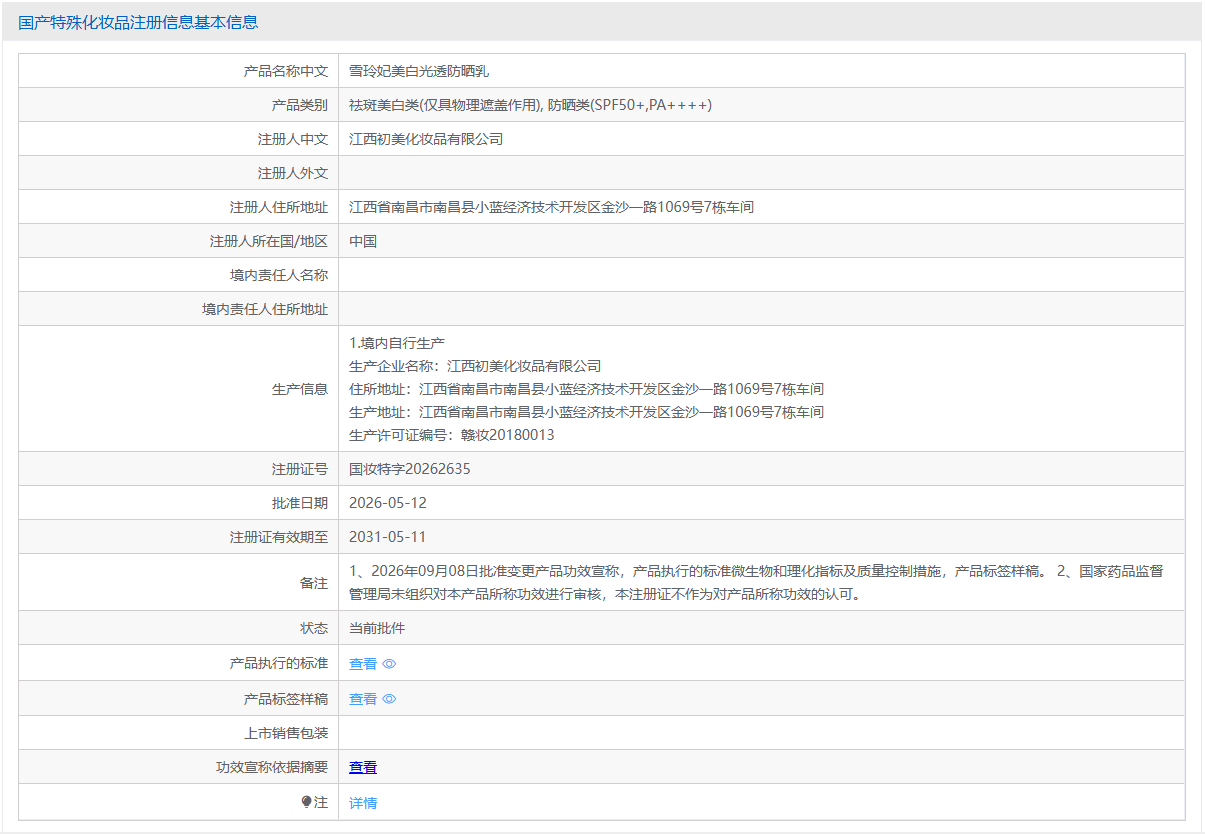
Result columns, with the Chinese label first:
- 产品名称中文 — product name (Chinese)
- 产品类别 — product category
- 注册人中文 / 注册人外文 — registrant name (Chinese / foreign language)
- 注册人住所地址 — registrant's registered address
- 注册人所在国/地区 — registrant's country or region
- 境内责任人名称 / 住所地址 — domestic responsible person: name and address
- 生产信息 — manufacturing information
- 注册证号 — registration certificate number
- 批准日期 / 注册证有效期至 — approval date / certificate valid until
- 状态 / 备注 — status / remarks
- 产品执行的标准、产品标签样稿、上市销售包装、功效宣称依据摘要 — product standard, draft product label, marketed package, and summary of efficacy claim evidence
Number format: 国妆特字 + four-digit year + registration sequence number of that year, for example 国妆特字20262635.
2.2 Imported special cosmetics
Same portal as above: https://datasearch.nmpa.gov.cn/datasearch/home-index.html#category=hzp
Searchable fields: product name in Chinese, product name in foreign language, product type, registrant name in Chinese, registration number.
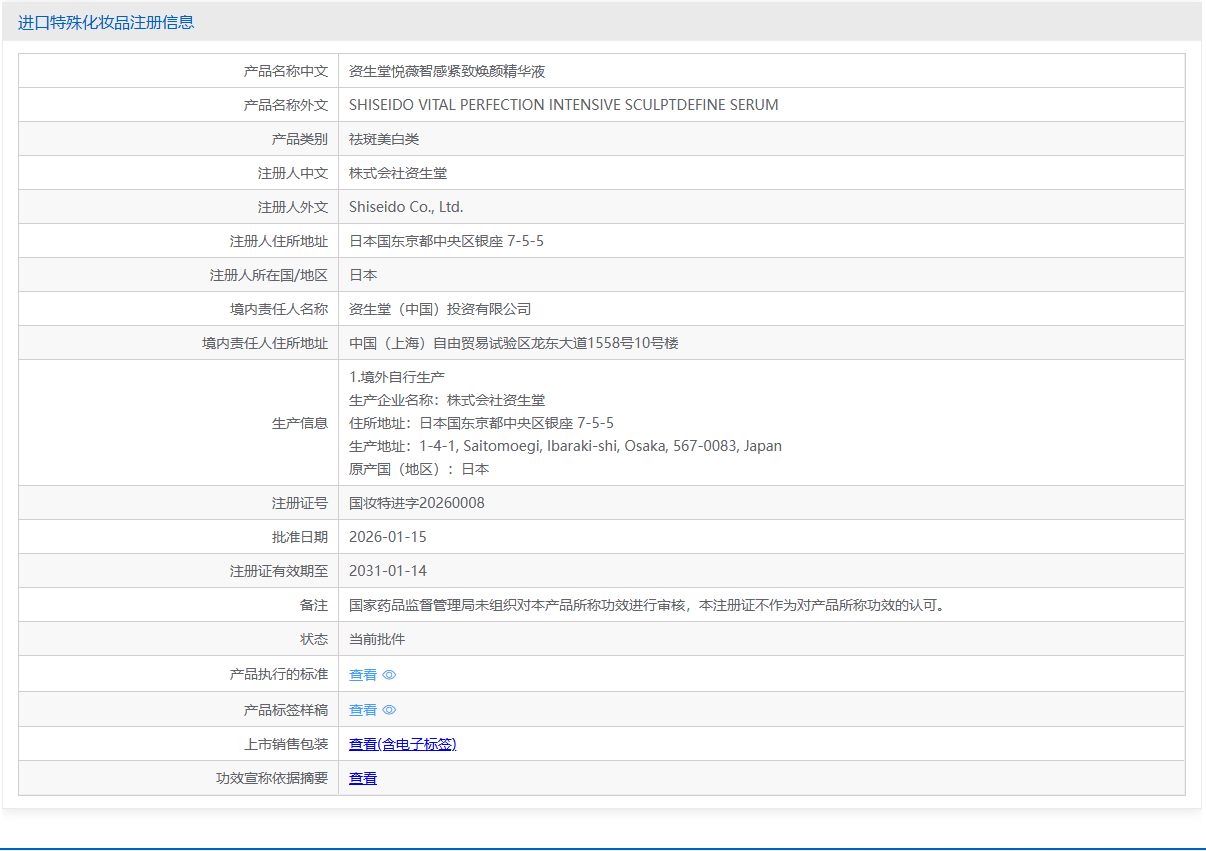
The result columns add 产品名称外文 (product name in foreign language) but otherwise match the domestic record: product name (Chinese), product category, registrant name (Chinese and foreign language), registrant address, registrant country/region, domestic responsible person name and address, manufacturing information, registration number, approval date, valid until, remarks, status, product standard, draft label, marketed package and efficacy claim evidence summary.
Number format: 国妆特进字 + four-digit year + sequence number, for example 国妆特进字20260008.
3. General cosmetics notification
General cosmetics are notified before marketing. If you hold the notification number or the notifier's name, you can retrieve every record in the public notification system.
3.1 Domestic general cosmetics
Query portal: https://hzpba.nmpa.gov.cn/gccx/
The system allows exact match only and requires a captcha. Choose one of three keys: product name, notification number, or notifier company name.
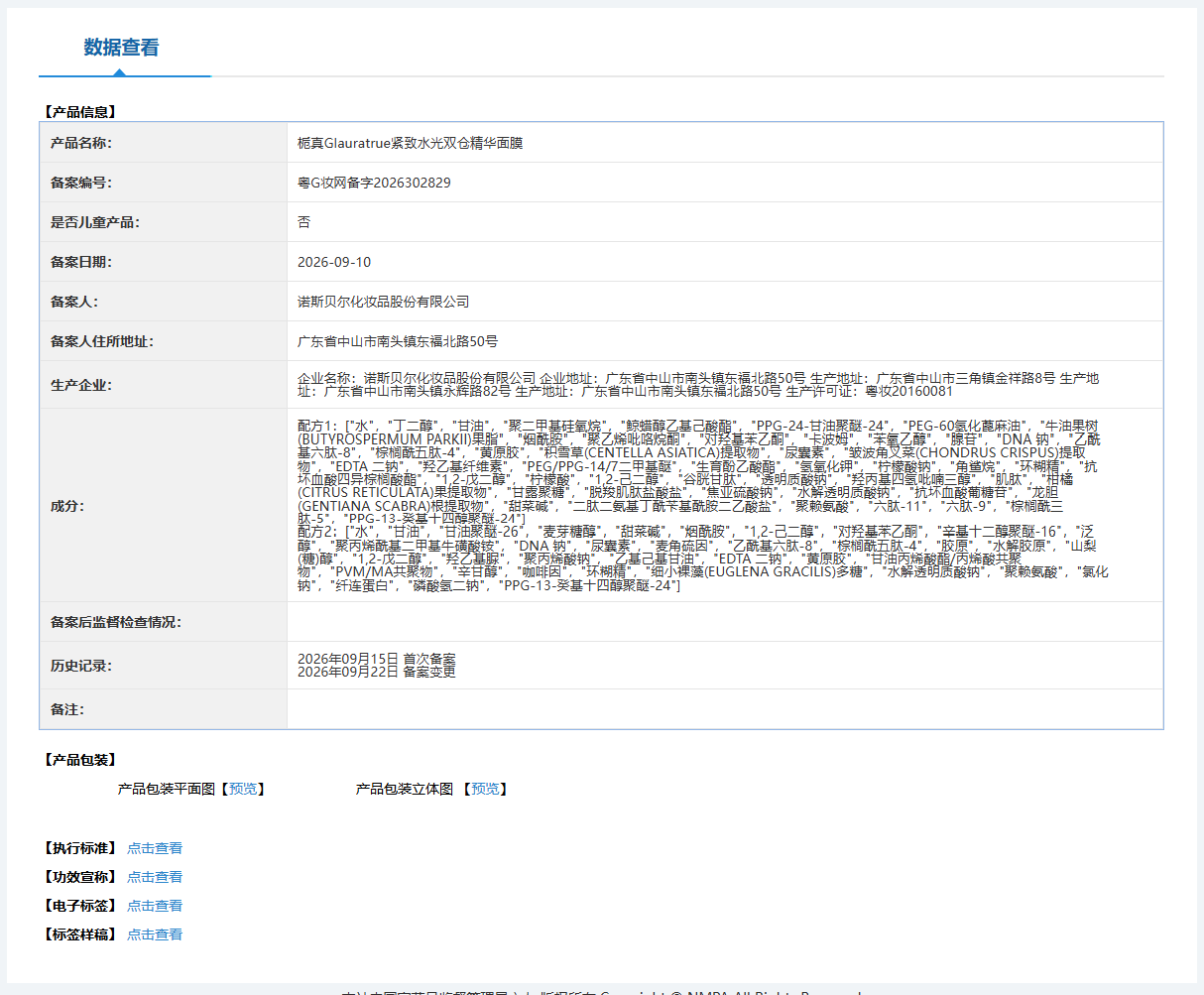
Result columns: product name, notification number, children's product flag, notification date, notifier, notifier address, manufacturer, ingredients, post-notification inspection records, history, remarks, product package, product standard, efficacy claims, electronic label and draft label.
Number format: province abbreviation + G妆网备字 + four-digit year + sequence number within that province for the year, for example 粤G妆网备字2026302829.
3.2 Imported general cosmetics and imported toothpaste
Query portal: https://hzpba.nmpa.gov.cn/jkcx/
Again exact match plus captcha. Choose one of three keys: product name, notification number, or domestic responsible person company name.
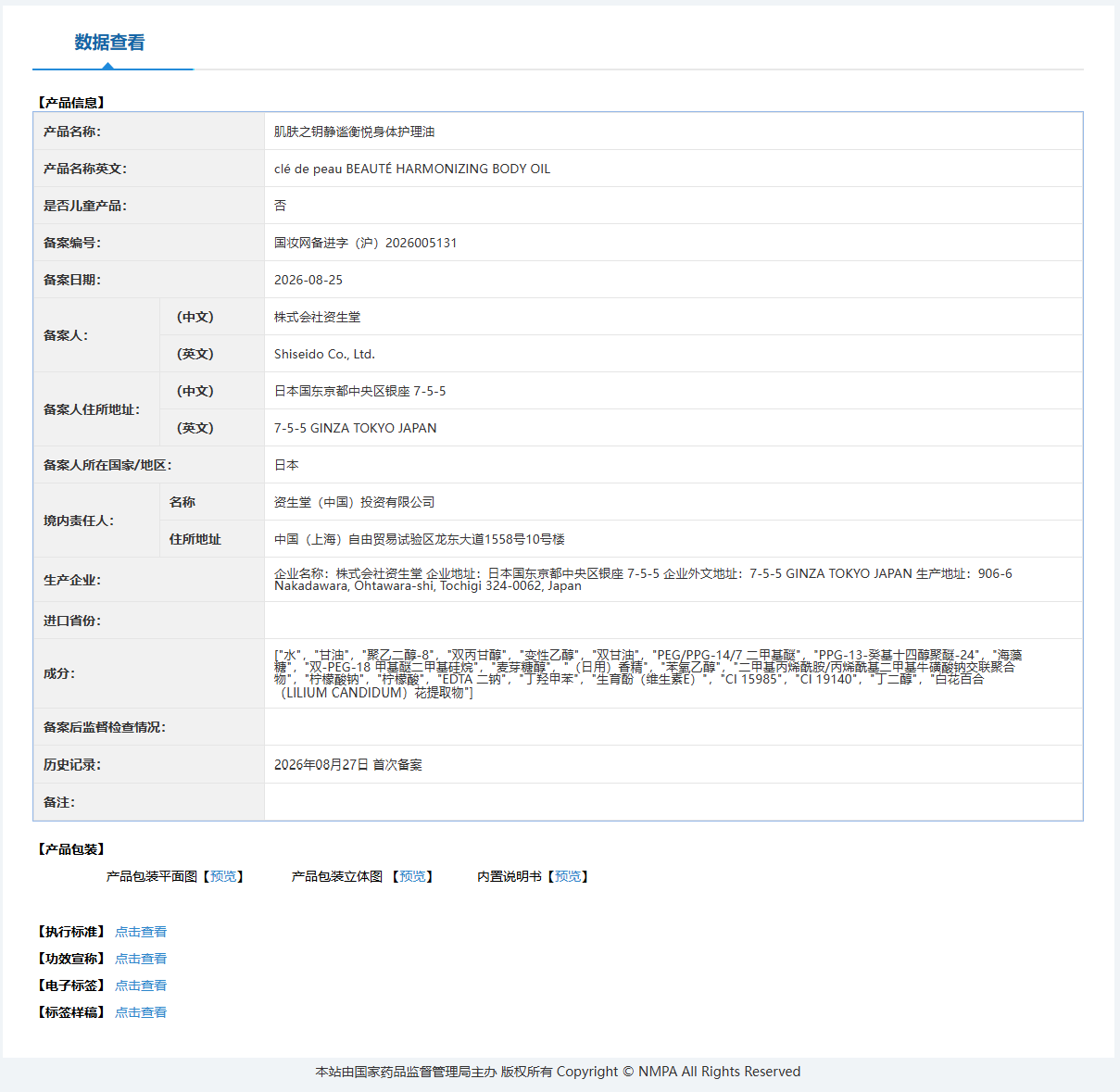
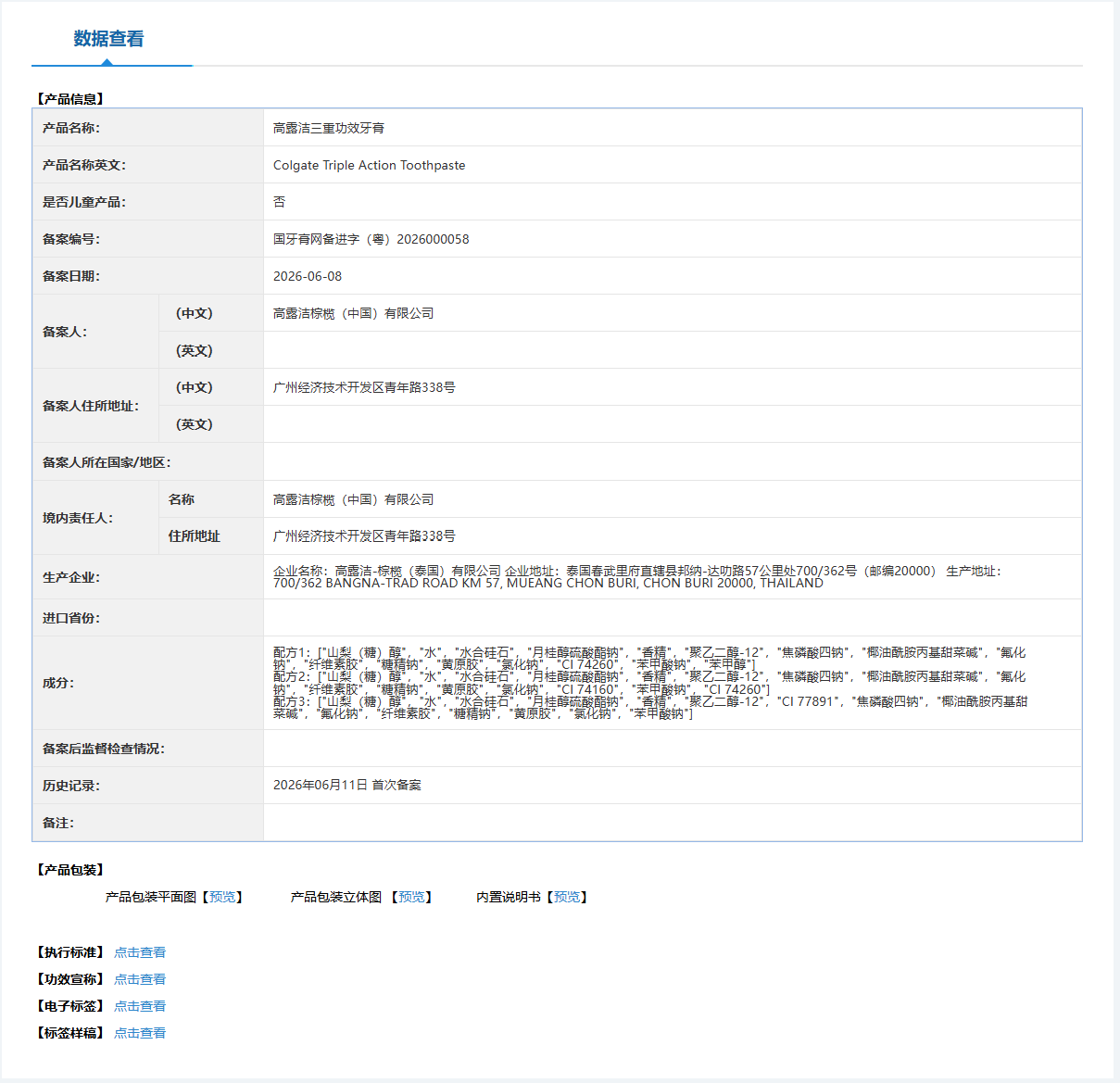
Result columns: product name in Chinese, product name in English, children's product flag, notification number, notification date, notifier name in Chinese and English, notifier address in Chinese and English, notifier country or region, domestic responsible person name and address, manufacturer, importing province, ingredients, post-notification inspection records, history, remarks, product package, product standard, efficacy claims, electronic label and draft label.
Number format, general cosmetics: 国妆网备进字 + province abbreviation in brackets + four-digit year + sequence number, for example 国妆网备进字(沪)2026005131. Number format, imported toothpaste: 国牙膏网备进字 + province abbreviation in brackets + four-digit year + sequence number, for example 国牙膏网备进字(粤)2026000058.
4. Domestic toothpaste
Toothpaste is defined as a paste product applied to the surface of teeth by friction, mainly for cleaning. It is subject to notification management; the notifier is responsible for quality, safety and efficacy claims. Domestic toothpaste must be notified with the provincial medical products administration where the notifier is located before it is put on the market.
Query portal (NMPA Data Query, cosmetics section): https://datasearch.nmpa.gov.cn/datasearch/home-index.html#category=hzp
Searchable fields: product name, notification number, or notifier.
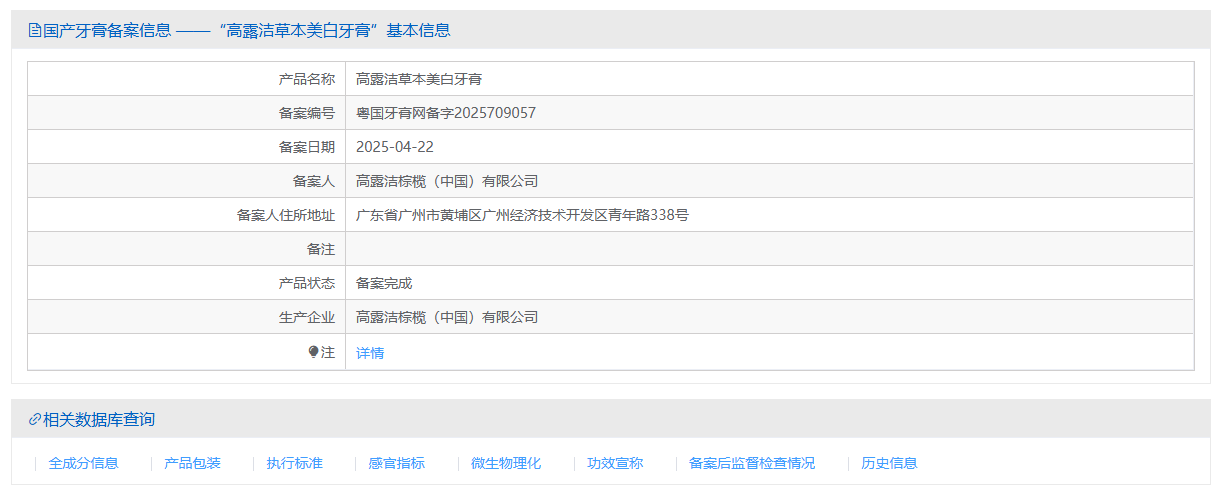
Result columns: product name, notification number, notification date, notifier, notifier address, remarks, product status, manufacturer, full ingredient information, product package, product standard, sensory indices, microbiological and physicochemical indices, efficacy claims, post-notification inspection records and history.
Number format: province abbreviation + 国牙膏网备字 + four-digit year + sequence number, for example 粤国牙膏网备字2025709057.
5. Cosmetic new ingredients
Any natural or artificial ingredient used in cosmetics for the first time within China is a new cosmetic ingredient. Ingredients with higher risk are subject to registration; all others must be notified before first use. When the three-year safety monitoring period expires, the technical review body reports to the NMPA on whether the ingredient meets safety requirements. Unsafe ingredients have their registration revoked or notification cancelled; safe ones are moved into the Inventory of Existing Cosmetic Ingredients.
5.1 Registered new ingredients
Registration applies to new ingredients having preservative, UV-filter, colourant, hair-dyeing or spot-fading and skin-whitening functions. Reference definitions, useful when reading Chinese technical files:
- Preservative — a substance added to inhibit the growth of micro-organisms in the cosmetic.
- UV-filter — a substance that absorbs, reflects or scatters light to protect skin from specific ultraviolet radiation, or to protect the product itself.
- Colourant — a substance that gives colour by absorbing or reflecting visible light, excluding the hair dyes listed in Table 7, Chapter 3 of the Safety and Technical Standards for Cosmetics.
- Hair dye — a substance added to change hair colour where the original colour cannot be restored by immediate rinsing.
- Spot-fading and skin-whitening agent — a substance that reduces or slows skin pigmentation to lighten and whiten skin, including by physical covering.
Query portal: https://datasearch.nmpa.gov.cn/datasearch/home-index.html#category=hzp
Searchable fields: standard Chinese name, registration number, registrant name in Chinese, registrant name in foreign language.
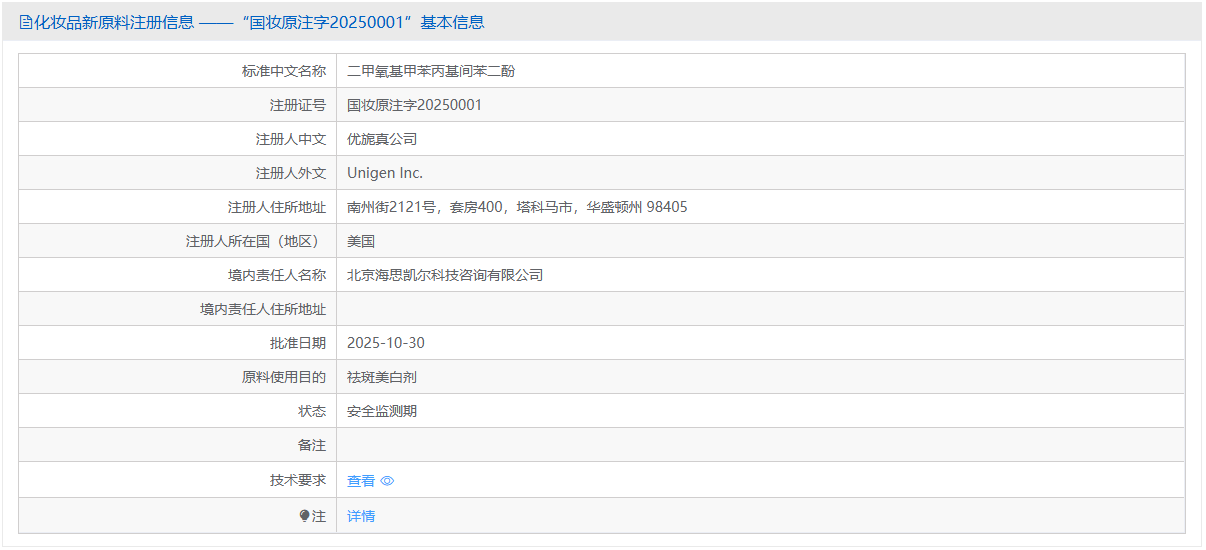
Result columns: standard Chinese name, registration number, registrant name in Chinese and foreign language, registrant address, registrant country or region, domestic responsible person name and address, approval date, intended use of the ingredient, status, remarks and technical requirements.
Number format: 国妆原注字 + four-digit year + sequence number, for example 国妆原注字20250002.
5.2 Notified new ingredients
Notifications are filed under six scenarios: ingredients with or without the five functions listed above; the same two categories where there is sufficient evidence of a safe use history of more than three years in cosmetics; ingredients with sufficient evidence of a safe history of consumption; and polymers made of one or more structural units linked by covalent bonds with a number-average relative molecular mass above 1000 Da, less than 10% oligomer below 1000 Da, and stable structure and properties, excluding those with relatively high biological activity.
Query portal: https://datasearch.nmpa.gov.cn/datasearch/home-index.html#category=hzp
Searchable fields: standard Chinese name, notification number, notifier name in Chinese, notifier name in foreign language.
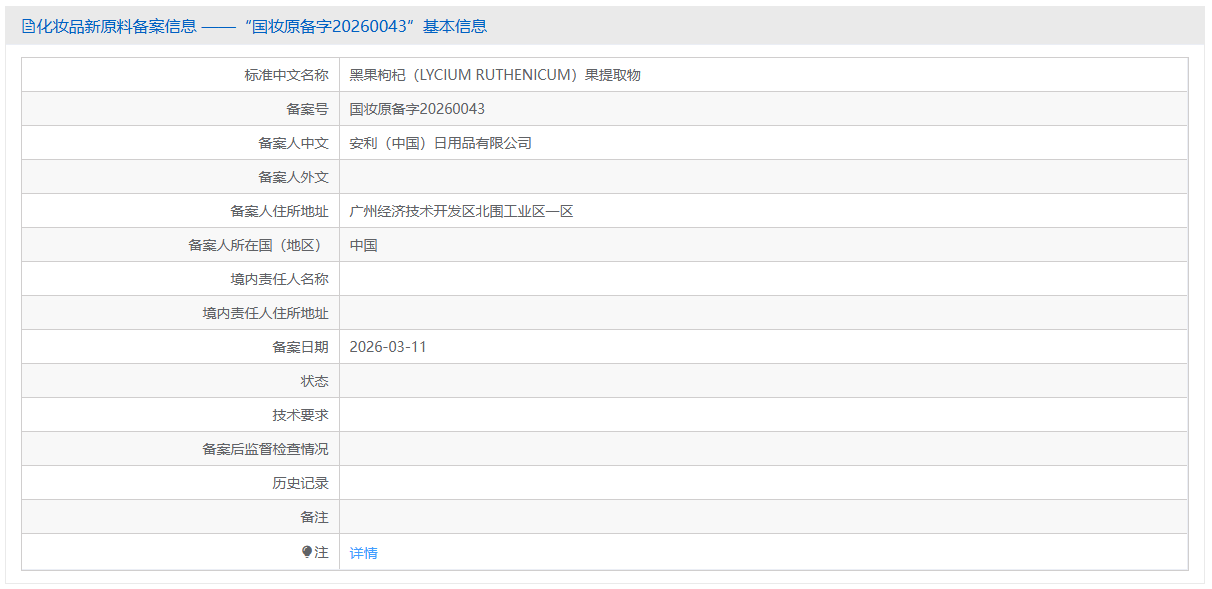
Result columns: standard Chinese name, notification number, notifier name in Chinese and foreign language, notifier address, notifier country or region, domestic responsible person name and address, notification date, status, technical requirements, post-notification inspection records, history and remarks.
Number format: 国妆原备字 + four-digit year + sequence number, for example 国妆原备字20260043.
Drug regulatory authorities publish registration and notification information within five working days of approval or completion of notification.
6. Existing cosmetic ingredients
An ingredient that is not new is an existing cosmetic ingredient. Changing the intended use or the safe use level of an existing ingredient requires a new registration or notification. Since 23 June 2025, the Inventory of Existing Cosmetic Ingredients has been maintained dynamically under NMPA Announcement No. 61 of 2025 rather than republished in full.
6.1 Inventory of Existing Cosmetic Ingredients, list I
List I is a localised revision of the 2021 inventory, covering ingredients already used in cosmetics produced and sold in China; the highest historical use level column was removed, Chinese and INCI or English names were standardised, and remarks were aligned with the Safety and Technical Standards for Cosmetics. List II is described in section 6.2.
Query portal (NIFDC): https://hzpsys.nidc.org.cn/hzpGS/ysyhzpylmla
Searchable fields: serial number, Chinese name, INCI name or English name.
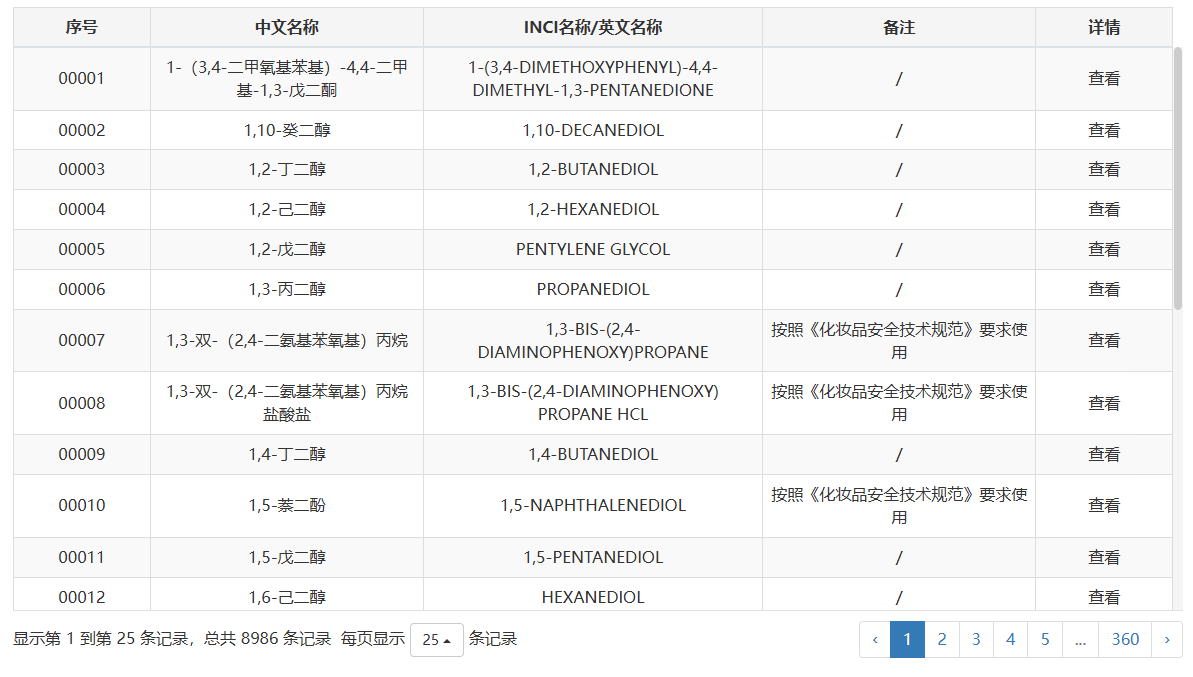
Result columns: serial number, Chinese name, INCI or English name, remarks, date of inclusion in the inventory and history. Reading tips for names: in the INCI name or English name column, italic text indicates an English name rather than an INCI name; a name written as 某某植物提取物 implies the whole plant and its extracts are covered, and the specific part used must be stated; names marked with one asterisk are collective generic names that require the specific ingredient name plus proof of prior registered or notified use in China; names marked with two asterisks have non-standard wording or unclear plant or animal origin and require a standardised specific name plus the same proof.
6.2 Inventory of Existing Cosmetic Ingredients, list II
The inventory is managed as two lists. List II collects cosmetic new ingredients that have been registered or notified in China, whose safety monitoring period has expired and which meet the conditions for inclusion in the inventory. In other words, list II is the route by which a former new ingredient becomes an ordinary existing ingredient, and checking it is the standard way to confirm that transition.
Two features distinguish list II from list I. First, the use purpose and safe use level recorded for each ingredient come from the research dossier submitted by the registrant or notifier of the new ingredient; they are evaluated boundaries, so adjusting them requires the new-ingredient registration or notification procedure described in section 5. Second, where the source or manufacturing process of an ingredient has a material impact on its substance basis or quality and safety, the remarks column records it, for example the species, the part used, a brief description of the process, the strain source or the cell source. For botanical extracts and biotechnology-derived ingredients that column decides whether the substance basis matches.
Where an ingredient in either list is managed as a prohibited, restricted or permitted ingredient, the registrant or notifier must select and use it in accordance with the mandatory national standards and technical specifications. Inclusion in a list is not a safety endorsement: both lists are factual records, and the safety assessment obligation stays with the registrant or notifier.
| Item | List I | List II |
|---|---|---|
| Scope | In-use | After 3 years |
| Basis | 2021 text | Dossier |
| Search | 3 fields | 6 fields |
| Result | 6 items | 14 items |
| Portal | See 6.1 | See 6.2 |
Query portal (NIFDC): https://hzpsys.nidc.org.cn/hzpGS/ysyhzpylmlb
Searchable fields (6): serial number, Chinese name, INCI name, English name, CAS number, use purpose.
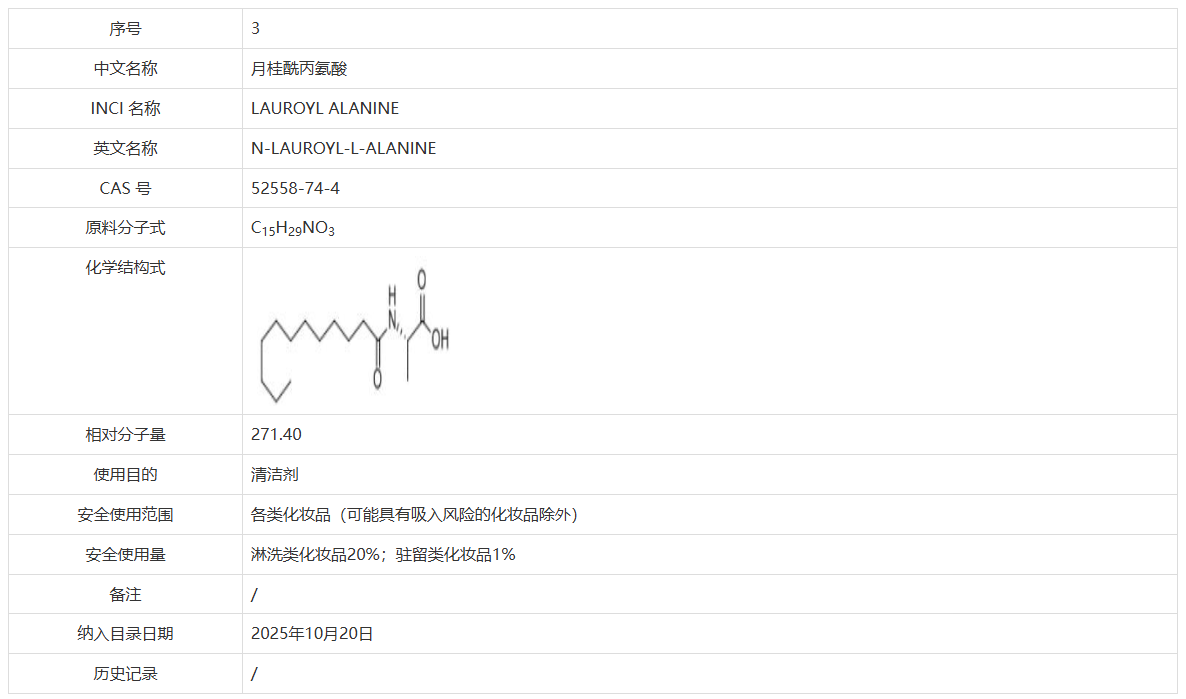
Result fields (14), in the order shown on screen: 序号 serial number; 中文名称 Chinese name; INCI名称 INCI name; 英文名称 English name; CAS号 CAS number; 原料分子式 molecular formula; 化学结构式 chemical structure; 相对分子量 relative molecular mass; 使用目的 use purpose; 安全使用范围 safe use scope; 安全使用量 safe use level; 备注 remarks; 纳入目录日期 date of inclusion in the inventory; 历史记录 history.
Worked example, serial number 3 of list II: 月桂酰丙氨酸, Lauroyl Alanine. INCI name LAUROYL ALANINE; English name N-LAUROYL-L-ALANINE; CAS number 52558-74-4; molecular formula C15H29NO3; relative molecular mass 271.40; use purpose 清洁剂 cleanser; safe use scope 各类化妆品(可能具有吸入风险的化妆品除外)all cosmetics except those with a possible inhalation risk; safe use level 淋洗类化妆品20%;驻留类化妆品1%, which reads rinse-off cosmetics 20 per cent and leave-on cosmetics 1 per cent; date of inclusion 20 October 2025. The example shows how narrow a list II entry can be: an ingredient cleared as a cleanser at 20 per cent in rinse-off products is not thereby cleared for every cosmetic category.
6.3 Information on ingredients used in marketed products
This dataset is an objective record of use levels of ingredients already used in validly registered or notified cosmetics that are not yet covered by the Safety and Technical Standards for Cosmetics or by international authoritative safety assessment indexes. No systematic safety review was organised for these ingredients; registrants and notifiers remain responsible for compliance and safety assessment, and must judge applicability according to their own product usage method and application site.
Download (NIFDC): https://www.nidc.org.cn/directory/web/nifdc/images/2025020914193035193.xlsx
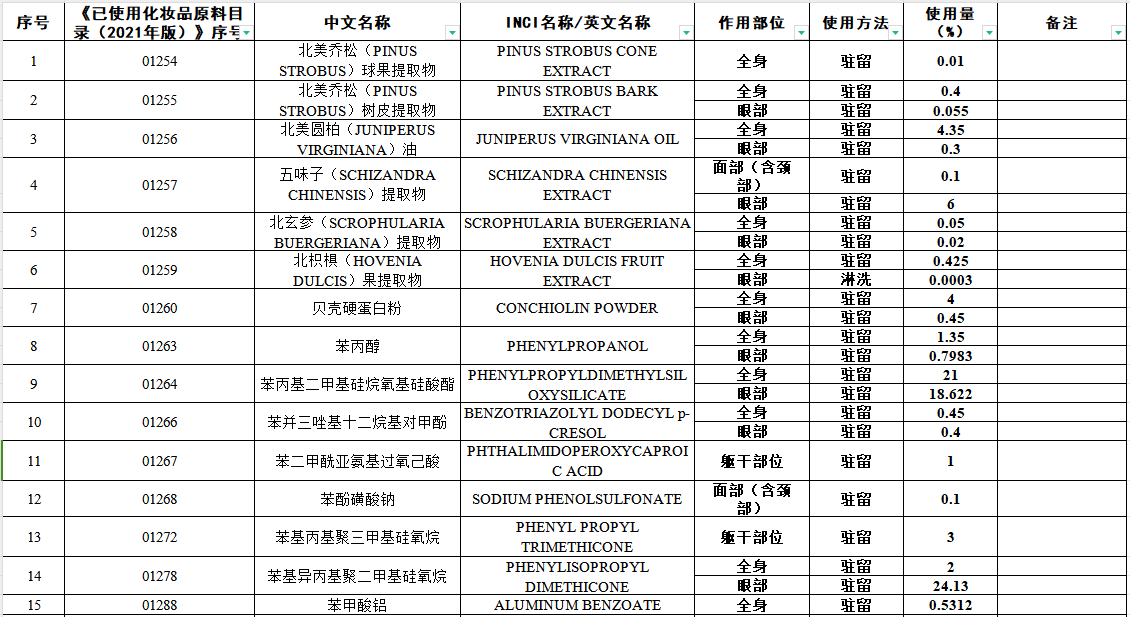
Columns: serial number, serial number in the 2021 Inventory, Chinese name, INCI or English name, application site, usage method, use level in percent, and remarks. Where only leave-on data exists for the same application site, rinse-off products may refer to leave-on use levels; for the same usage method there is a reference order across body sites, and eye-area references require an additional eye irritation assessment.
6.4 Partial use information from the International Cosmetic Safety Assessment Data Index
A companion dataset published by NIFDC covering ingredients included in international authoritative safety assessment sources.
Download (NIFDC): https://www.nidc.org.cn/directory/web/nifdc/infoAttach/68940590-a05f-4458-9343-d962459a5651.xlsx
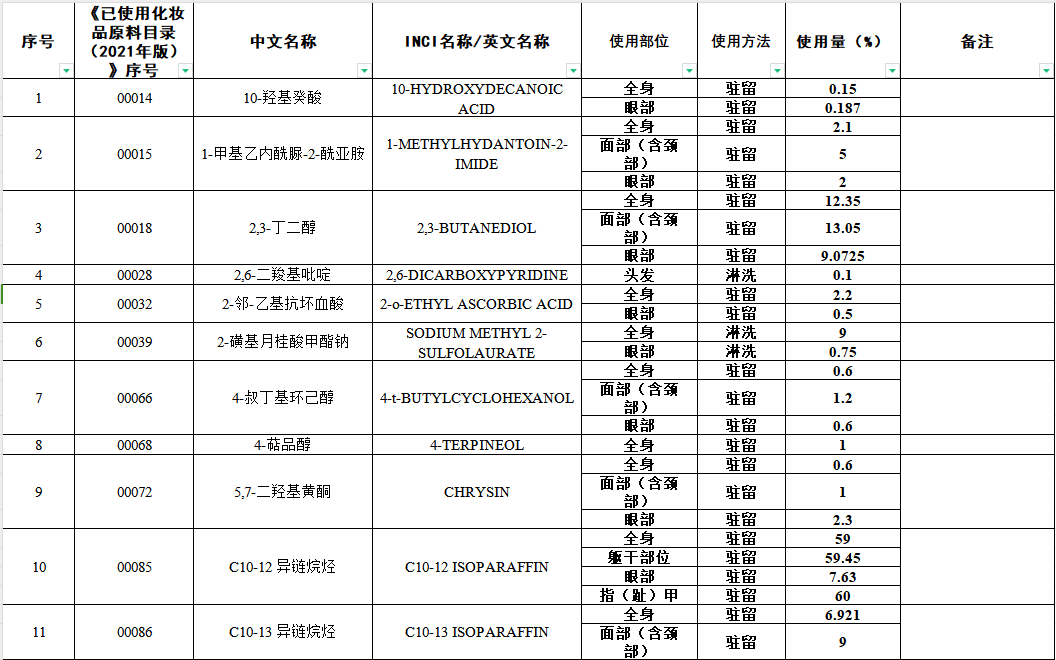
Columns are identical to section 6.3: serial number, 2021 Inventory serial number, Chinese name, INCI or English name, application site, usage method, use level in percent and remarks.
7. Cosmetic manufacturers
Any company manufacturing cosmetics in China must hold a cosmetic production licence issued by a provincial medical products administration. Searching the register is the standard step for supplier qualification, contract manufacturer selection and distributor onboarding.
Query portal (NMPA Data Query, cosmetics section): https://datasearch.nmpa.gov.cn/datasearch/home-index.html#category=hzp
Searchable fields: manufacturer name or licence number.
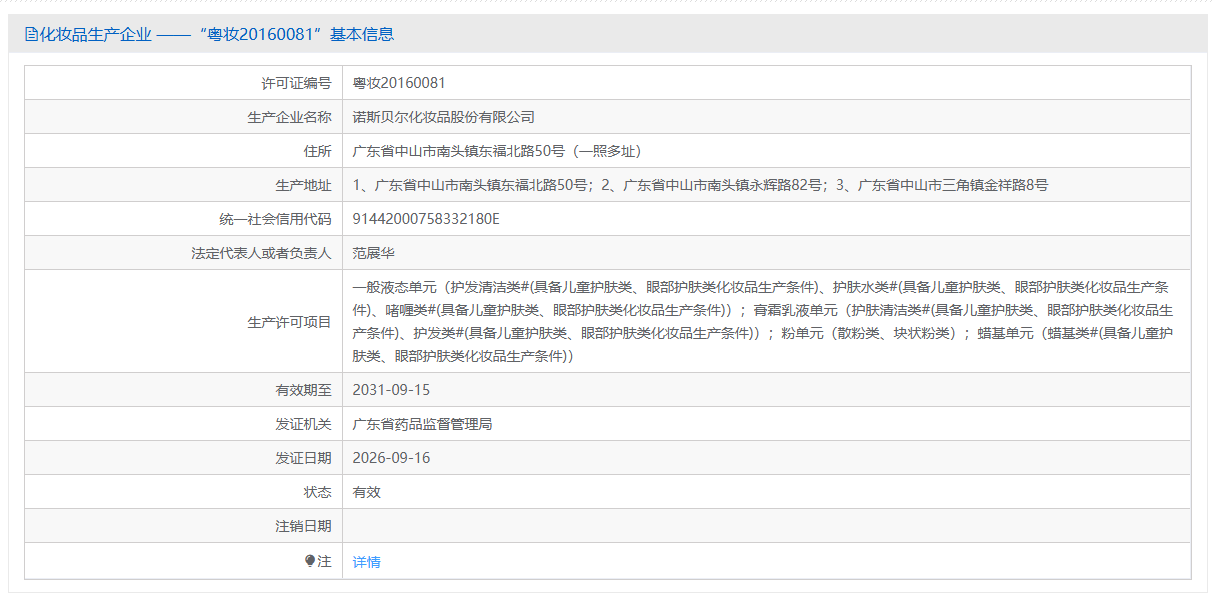
Result columns, with the Chinese label first:
- 许可证编号 — licence number
- 生产企业名称 — manufacturer name
- 住所 — registered domicile
- 生产地址 — actual production site address
- 统一社会信用代码 — unified social credit code
- 法定代表人或者负责人 — legal representative or person in charge
- 生产许可项目 — licensed production items
- 有效期至 — valid until
- 发证机关 — issuing authority
- 发证日期 — issue date
- 状态 — status
- 注销日期 — cancellation date
Licensed production items are listed by production unit and product category, and state whether the site is qualified to produce children's skin care cosmetics and eye-area skin care cosmetics. A production licence is valid for five years; domicile and production site may differ, so both must be checked against your contract and purchase orders.
8. Decoding Chinese registration and notification numbers
The prefix alone tells you the pathway and origin of a product or ingredient.
| Prefix | What it means | Example |
|---|---|---|
| 国妆特字 | Registered domestic special cosmetic | 国妆特字20262635 |
| 国妆特进字 | Registered imported special cosmetic | 国妆特进字20260008 |
| G妆网备字 | Notified domestic general cosmetic | 粤G妆网备字2026302829 |
| 国妆网备进字 | Notified imported general cosmetic | 国妆网备进字(沪)2026005131 |
| 国牙膏网备字 | Notified domestic toothpaste | 粤国牙膏网备字2025709057 |
| 国牙膏网备进字 | Notified imported toothpaste | 国牙膏网备进字(粤)2026000058 |
| 国妆原注字 | Registered new cosmetic ingredient | 国妆原注字20250002 |
| 国妆原备字 | Notified new cosmetic ingredient | 国妆原备字20260043 |
The four digits after the prefix give the year of approval or notification, and the trailing serial number restarts each year, so a sequence position cannot be compared across years.
References (official sources)
| Document or system | Issued by | What it is used for |
|---|---|---|
| NMPA data query, cosmetics | NMPA | Special cosmetics and toothpaste |
| Cosmetics filing system | NMPA | Domestic and imported filings |
| Cosmetic plant register | NMPA | Production licence checks |
| Existing ingredient inventory, list I | NIFDC | Is the ingredient already used |
| Existing ingredient inventory, list II | NIFDC | Is a former new ingredient now listed |
| Ingredient use levels, marketed products | NIFDC | Use levels for safety assessment |
| Inventory notice 61 of 2025 | NMPA | Dynamic update of the inventory |
| Cosmetics FAQ No. 8 | NMPA | Label changes after name edits |
- NMPA Announcement No. 61 of 2025 on matters concerning the management of the Inventory of Existing Cosmetic Ingredients (Chinese)
- Frequently asked questions on cosmetics supervision No. 8: management of the inventory (Chinese)
- NIFDC new domain launched: update citations to www.nidc.org.cn (Chinese)
Frequently asked questions
Where can I check whether a cosmetic is legally registered or notified in China?
Registration records for special cosmetics, domestic toothpaste, new cosmetic ingredients and manufacturing licences are published in the NMPA Data Query cosmetics section. Notification records for general cosmetics and imported toothpaste are published in the separate general cosmetics notification system. Both are free; no login is required for searching, though the notification system asks for a captcha.
Why do I get no result even though I typed the product name exactly?
The databases mostly use exact matching, so an extra space, a brand nickname or an English name returns nothing. Try the registration or notification number instead, or search by the notifier or registrant name and compare records one by one. Newly approved products are published within five working days of approval, so a very recent record may simply not be online yet.
How do I tell domestic from imported, and does it change where I search?
The test is where the last process that comes into contact with the contents is completed, not where the brand owner sits. For combination packs, if any single unit completes that process overseas the whole set counts as imported, and products completed in Taiwan, Hong Kong and Macao are managed by reference to imported products. Domestic and imported records live in different search modules, so choosing the wrong one returns no result.
Can I look a product up by its number alone?
Yes, and it is the most reliable search key. Numbers are unique and unaffected by how the product name is written. Registration numbers work for special cosmetics, notification numbers for general cosmetics, domestic toothpaste and new ingredients, and licence numbers for manufacturers. Ask your supplier for the number rather than the product name whenever you need to verify a claim.
What can I see for a registered special cosmetic?
Beyond basic data, the public record includes the product category, registrant and domestic responsible person details, manufacturing information, approval date and expiry date of the certificate, status and remarks, the product standard applied, the draft label, images of the marketed package and the summary of efficacy claim evidence. Imported records additionally show the product name in the original language.
How do I check a general cosmetics or imported toothpaste notification?
Use the notification system and enter exactly one of three keys: product name, notification number, or company name of the notifier for domestic products and of the domestic responsible person for imported products. The record shows the notification date, notifier, manufacturer, ingredients, product package, product standard, efficacy claims, electronic label and draft label, plus post-notification inspection records and change history.
Where do I check toothpaste?
Domestic toothpaste is queried through the NMPA Data Query cosmetics section using the product name, notification number or notifier. Imported toothpaste sits inside the imported general cosmetics notification module, together with ordinary imported products, and its number uses the 国牙膏网备进字 prefix rather than 国妆网备进字.
How do I check whether an ingredient is new or already an existing ingredient?
Search list I of the Inventory of Existing Cosmetic Ingredients by Chinese name, INCI name or serial number to confirm existing status, then check list II for formerly new ingredients whose three-year monitoring period has expired. Ingredients still outside both lists appear in the NMPA new ingredient register or notification list, where status and remarks show whether they remain inside the safety monitoring period.
How do I verify a Chinese manufacturer?
Search the cosmetics manufacturer module by company name or licence number. Confirm that the licence status is active, that the licensed production items cover your product category, that the validity period has not expired, and that the production site address matches the factory named in your supply documents. Where the registered domicile and production site differ, the production site is the one that matters.
Can I use a screenshot of the search result as compliance proof?
A screenshot works as supporting evidence for internal records, marketplace onboarding or distributor due diligence, but it is not an official certificate. Capture the full page including the query date and the complete URL, and keep it with the draft label, marketed package and efficacy claim evidence. For anything requiring legal effect, obtain the original registration certificate or notification record from the registrant or notifier.